UI/UX design for B2B companies comes from seven kinds of providers: specialized B2B design agencies, enterprise UX consultancies, SaaS product studios, full-service digital agencies, subscription design services, freelancers, and in-house teams. Each exists because B2B products need something consumer work doesn't, and picking the wrong category wastes money faster than picking the wrong vendor within it.
This guide maps the whole landscape. What each provider type is, what they're good at, and how to match one to your situation, with a short vetting method at the end. If you're researching on behalf of a company that sells to other companies, this is the honest version.
Who Provides UI/UX Design for B2B Companies
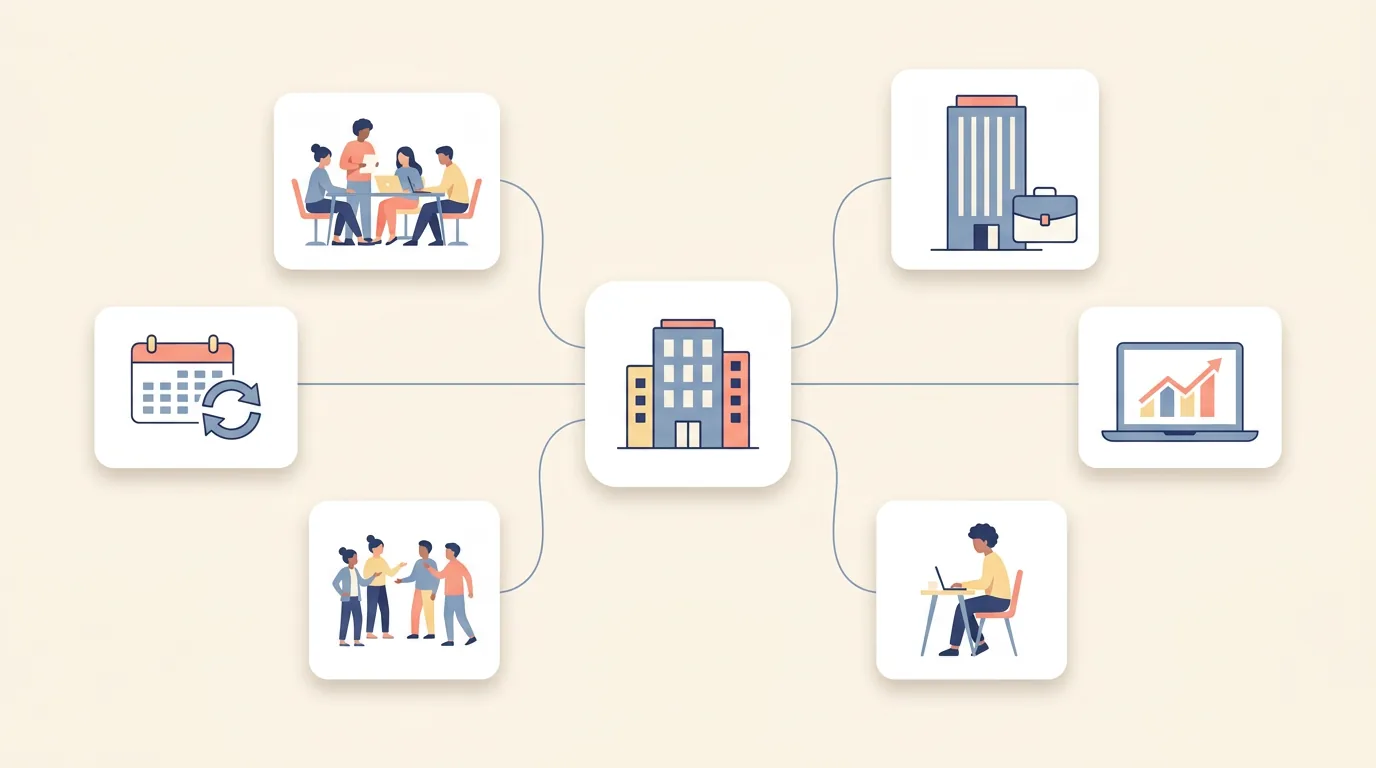
Here's the direct map. Specialized B2B and product design agencies handle platforms, dashboards, and complex workflows. Enterprise UX consultancies take on large-scale systems, internal tools, and multi-role software. SaaS-focused studios live inside subscription products and own onboarding, retention, and product UI. Full-service digital agencies cover design plus brand, web, and marketing under one contract. Subscription design services sell ongoing design capacity for a flat monthly fee. Freelancers handle bounded tasks and early concepts. In-house teams own product design as a permanent internal function.
Around these sit two hybrids worth knowing: embedded or team-extension models, where an outside designer joins your team as if in-house, and white-label partners, where agencies quietly do the design work for other agencies.
Every B2B company eventually uses a mix of these. The mistake isn't choosing a "wrong" provider type, it's matching a provider to a situation they weren't built for, like hiring a freelancer to redesign a 14-role enterprise platform.
Why B2B Design Is Its Own Discipline
If B2B design were just "business-looking design," anyone could do it. The discipline exists because B2B products carry constraints consumer apps never see.
Users are roles, not people. An enterprise product might serve an admin configuring permissions, a manager reading reports, and an end user doing daily tasks, all with different goals in the same system. Designing for one of them breaks the others. Multi-role workflows, permission models, and dashboards that stay readable under data density are where generalist design skills hit their ceiling.
The buying decision is separate from the usage. In B2B, the person choosing the product often never uses it, and the people using it didn't choose it. Design has to win a buying committee (demos, procurement, security reviews) and then actually work for daily users. That dual audience shapes everything from the marketing site to the empty states.
And the environment resists clean-slate thinking. B2B products live next to legacy systems, integrations, compliance requirements, and workflows that exist for reasons nobody remembers. A designer who only ships pretty concepts drowns here; a B2B designer navigates it.
That's the competence you're shopping for, whichever provider type you pick.

The Provider Types, One by One
Specialized B2B design agencies live and breathe this world: platforms, dashboards, multi-role systems. Their case studies read like yours. They're the default choice for serious product work where complexity is the challenge.
Enterprise UX consultancies operate at the top of the market: large organizations, multi-year systems, research-heavy programs. Firms like IDEO and Frog anchored this category, and their consulting-grade processes suit transformations, not quick redesigns. The premium buys rigor, not speed.
SaaS product studios focus on subscription software specifically: onboarding, activation, dashboards, and the metrics behind them. If your B2B company sells software, this specialization maps almost one-to-one onto your needs.
Full-service digital agencies bundle UI/UX with branding, websites, and marketing. Sensible when the job spans a rebrand plus a site plus product support and you want one contract. The trade: breadth sometimes comes at the cost of product-design depth.
Subscription design services offer flat monthly design capacity. They suit steady streams of smaller requests, marketing assets, incremental UI work, better than deep product thinking. A supplement to product design, rarely a replacement.
Freelancers are ideal for bounded tasks: a landing page, a concept prototype, a specific flow. Skilled senior freelancers exist even in complex B2B, but one person holding an entire multi-role platform in their head is rare and usually booked solid.
In-house teams make sense once design demand is continuous. They build product knowledge no outsider matches, and they cost a salary whether or not there's work. Most B2B companies grow into in-house, often seeded by an agency's design system.
Embedded and white-label models blur the lines: an outside designer embedded in your team, or a partner working invisibly behind your brand. Both solve specific capacity problems, and both need tight quality control to work.

Matching the Provider to Your Situation
Situation decides, more than budget does.
A complex platform with many user roles and legacy constraints points to a specialized B2B agency or enterprise consultancy, depending on scale. A SaaS product that needs onboarding, activation, and retention work points to a SaaS-focused studio. A rebrand plus website plus ongoing marketing design points full-service. A steady drip of mid-sized tasks points to subscription services or an embedded designer. A single well-defined artifact points to a freelancer. And product design that never stops pointing to in-house, usually grown from an agency-built foundation.
Two questions cut through most confusion. How many distinct user roles must the design satisfy? And is this a one-time artifact or a continuous function? High roles plus continuous demand is enterprise territory. Low roles plus a bounded deliverable is freelancer territory. Everything else lives in between, which is why the middle of the market is so crowded.
How to Vet a B2B Design Provider
Keep it short and B2B-specific, because general vetting advice is everywhere.
First, case studies with roles in them. You want proof they've designed for admins, managers, and end users in one system, not just consumer-style screens. Second, research capability: ask how they learn a domain they don't know, because B2B work always requires it. Third, handoff quality: B2B builds involve engineers wrestling integrations, and ambiguous designs multiply that pain. Fourth, industry familiarity, meaning they've worked with your kind of buyer, not necessarily your industry.
Do those four checks and the provider type almost announces itself.
Two mistakes catch most B2B companies before they get to vetting, and they're worth naming. The first is buying the cheapest option for the most complex problem, usually a freelancer for an enterprise platform, which ends as the expensive story everyone tells afterward. The second is buying the biggest option for the simplest problem, a consultancy-sized engagement for a website refresh, which burns budget that the product actually needed. Match the weight of the provider to the weight of the problem and most decisions make themselves.
Cost signals run in predictable directions, for what it's worth. Enterprise consultancies price at the top and suit transformations. Specialized B2B agencies sit mid-market with the best complexity-per-dollar ratio for most platforms. Subscription services and freelancers anchor the bottom for bounded work. None of those bands are rules, but if a quote lands wildly outside the band for its provider type, there's a story there, and you should ask for it.
We'll close with our own card on the table, since Quadiz sits in this landscape too. We're a small product design and development studio that works the way B2B platforms need: design and development under one roof, multi-role products from SaaS dashboards to case studies you can check. If your B2B product needs a team that handles complexity without a consultancy-sized invoice, book a free call and let's see whether we fit.
Tags:#B2B UX#Enterprise Design#B2B SaaS
Written byFounder & Lead Developer
Nayef
Visit Website ↗Tech enthusiast, lead developer, and founder of Quadiz.