Wondering what a UX UI designer does all day is usually a sign you've read the job description and still can't picture the job. Understandable. The description lists responsibilities; the actual day is a rhythm of focused design work, conversations, tests, and small decisions, and the rhythm is what makes the role click.
So this isn't another definition. This is the day as it actually unfolds, morning to evening, then zoomed out to the weekly pattern, including how the shape changes between agencies, in-house teams, and freelance work. Definitions you can find anywhere. The texture of the job, you'll only get here.
What Does a UX UI Designer Do All Day
No two days match, and that's not a disclaimer, it's the job's actual texture. Some days are wall-to-wall creative work; some barely touch a design file. But a shape exists underneath the variation, and once you see it, the role stops being abstract.
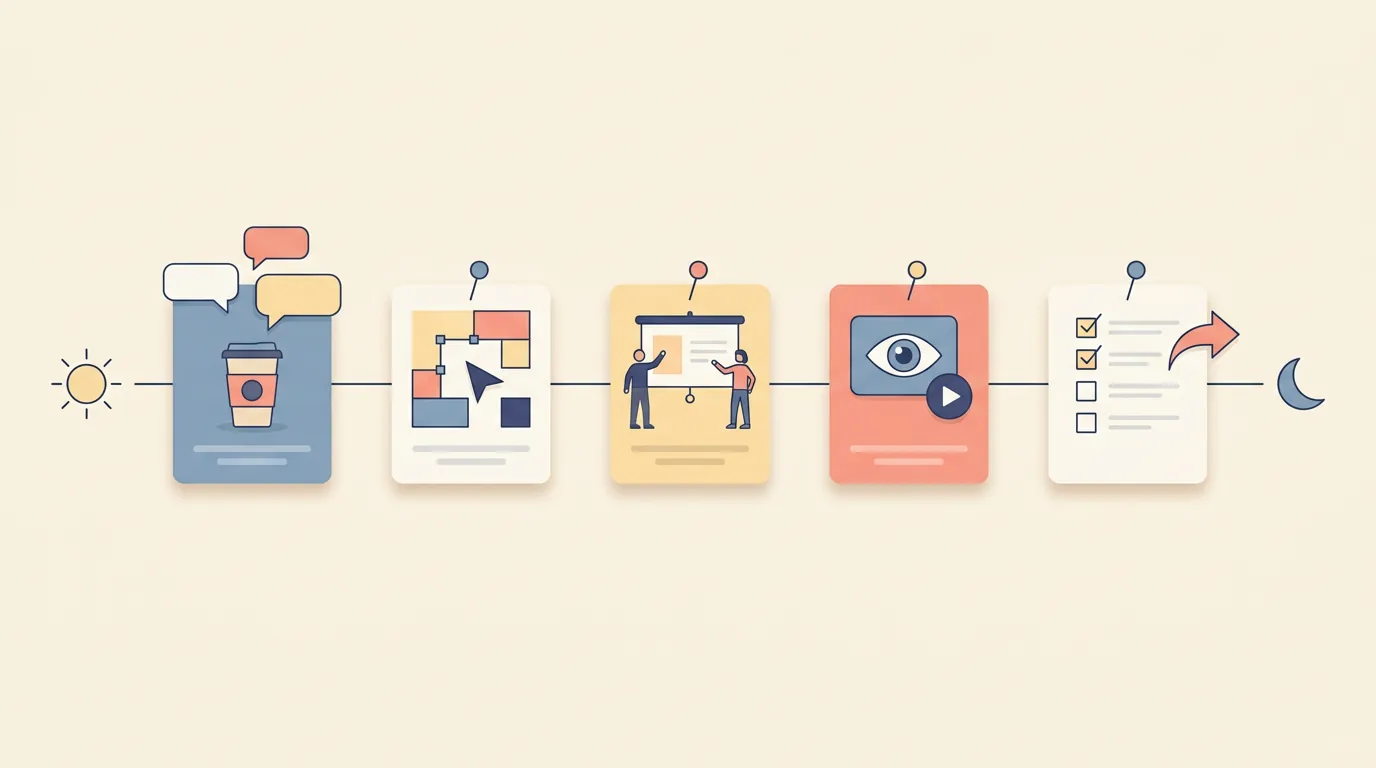
The day usually splits into four movements: catching up and prioritizing, a deep work block, collaborative hours, and user-or-handoff time. The proportions shift constantly. The movements don't.
The Morning: Catching Up and Prioritizing
Most designers open the day not to a canvas but to a conversation. Overnight, comments accumulated on shared files: a developer questioning a spacing detail, a product manager flagging an edge case, a stakeholder reacting to yesterday's mockups. Answering these early matters more than it sounds, because every unresolved question quietly blocks someone else's work.
Then the standup, usually fifteen minutes with product and engineering. What moved yesterday, what's moving today, what's blocked. For a designer, this is where the day gets its shape: the engineer building the checkout flow needs final specs by Thursday, today's testing session is confirmed for three participants, and the pricing page feedback landed.
By nine-thirty, the designer has triaged it all into a plan. Not a to-do list exactly, more like a betting sheet: what deserves the best hours of the day, and what can survive being done tired.
The Deep Work Block
Then comes the part of the day outsiders imagine, and it's real: several hours of focused design work in the design tool.
What fills the block depends on the project's phase. Early on, it's user flows and wireframes, arranging gray boxes until the logic of a screen becomes arguable. Mid-project, it's high-fidelity screens: layout, components, states, spacing, the craft of making a flow feel obvious. Late in a cycle, it's polishing prototypes, naming layers so developers don't curse the file, and writing the annotations that explain decisions.
The common thread is that all of it needs uninterrupted time. Design work has a peculiar cost structure: twenty minutes of focus produces more than two hours of fragmented attention, because the designer is holding an entire interface in their head, every state and every edge case at once. That's why you'll see calendar blocks marked as focus time and defended firmly. Interrupting a designer mid-screen doesn't cost a minute; it costs the rebuild of the whole mental model.

Midday: Reviews, Critique, and Quick Turns
After lunch, the day usually turns collaborative, and the energy shifts from maker to communicator.
Design reviews anchor this stretch: the designer walks the team through a flow, explains the thinking, and takes questions. Good reviews feel like sparring, not judgment. Why this layout and not the alternative? What happens when the data fails to load here? A designer who can't answer those gets sent back, and that's the system working.
Between reviews come the quick turns: a stakeholder asking for "one small change" that's actually a structural question, a comment thread that resolves into a ten-minute fix, a Slack ping from a developer who found an unstyled state nobody designed. These fragments look small and demand real judgment, because every yes reshapes the product somewhere downstream.
Critique runs in both directions, by the way. Giving it well, specific, kind, aimed at the work rather than the person, is as much a professional skill as receiving it without ego. Designers spend a surprising share of their day being wrong in public, and the good ones learn to treat that as the process rather than a verdict.
The Afternoon: Users, Handoffs, and Reality
The back half of the day pulls the designer out of the file and toward reality, in two forms.
The first is users. On testing days, the afternoon belongs to usability sessions: a participant shares their screen, the designer asks them to complete a task, and then stays quiet while the participant struggles exactly where the designer predicted, or worse, sails through it while missing the thing that mattered. Either result is data. Research interviews and survey analysis live in this same block.
The second is engineering. Handoff isn't a moment, it's a standing appointment: answering developer questions, reviewing what got built against what was designed, and catching the drift between the two. Design QA, where the designer clicks through a shipped feature hunting for the wrong border radius and the broken empty state, is unglamorous and completely non-optional. It's also how trust with engineering gets built: nothing teaches a developer what "done" looks like like a designer who checks.
Somewhere in here sits a sync with the product manager, reconciling what the business needs next with what the design can honestly deliver. Some afternoons, that conversation is the hardest design work of the day.

The Weekly Rhythm
Zoom out from the day and the week has its own weather system.
Research-heavy weeks feel like journalism: interviews, synthesis, mapping findings into plans. Build-heavy weeks feel like craft: screens flowing one after another. Meeting-heavy weeks, the ones designers complain about most, still produce something: aligned decisions that make the next build week coherent. Sprint cadence shapes it all, with reviews and planning landing like a metronome, and every few weeks there's a presentation, to leadership or clients, that turns a folder of screens into a story.
The best designers actively manage this rhythm instead of enduring it: batching meetings to protect deep-work blocks, scheduling testing early in the week so findings can shape Friday's decisions. The calendar is a design artifact too.
How the Day Differs by Workplace
The same role tastes different in three settings.
Agency designers run multiple projects at once, so their days switch contexts constantly: one client's dashboard in the morning, another's mobile app after lunch. More variety, more polish expectations, more presenting. The pace teaches speed and range.
In-house designers go deep on one product for months or years. Their days carry more research, more data, more iteration on the same surfaces, and more influence over strategy. The trade is variety.
Freelancers do all of the above plus the business: scoping, invoicing, client management. Their design hours are what survive after that. The freedom is real and so is the overhead.
Three workplaces, one constant: the work alternates between making things and making sure the things matter. If that alternation sounds appealing rather than exhausting, that's probably a sign about you.
That rhythm is how we run design at Quadiz, for what it's worth: deep-work blocks defended, users in the room weekly, and developers who never receive a surprise. Our case studies show what the rhythm produces, and our design team carries products from first wireframe to launch. If you'd rather have that day happen for your product than read about it, book a free call and let's put it to work.
Tags:#Designer Day#UX UI Work#Design Career
Written byFounder & Lead Developer
Nayef
Visit Website ↗Tech enthusiast, lead developer, and founder of Quadiz.