A startup UI/UX design agency is a design partner built for zero-to-one work: unclear requirements, changing scope, tight runway, and products that need to impress users and investors with the same screens. It's a different job from designing for established companies, and the difference decides whether the engagement helps or burns money you didn't have.
If you're a founder weighing design help right now, this guide covers the honest version: what these agencies are, what design help you actually need at each stage, when a freelancer beats an agency, what a good MVP engagement delivers, and how to pick a partner without getting burned.
What Is a Startup UI/UX Design Agency
It's a design agency whose process, pricing, and headcount are built around early-stage products rather than enterprise retainers. In practice that means three things.
Speed to first artifacts. Startups need wireframes and clickable prototypes in weeks, not quarter-long discovery phases, and startup-focused agencies structure their process accordingly.
Comfort with ambiguity. The brief will change. A startup agency treats changing direction as normal workflow, with phases short enough that a pivot doesn't torch months of work. Enterprise agencies, used to locked specifications, often struggle here.
Business fluency. The right agency talks about conversion, activation, and investor demos, not just aesthetics, because at startup stage the design usually has two audiences: your users and the people deciding whether to fund you.
Not every agency that lists "startups" on its site actually works this way. Some just mean they'll take your money like any other client. The tests come later in this guide.
What Design Help Startups Actually Need at Each Stage
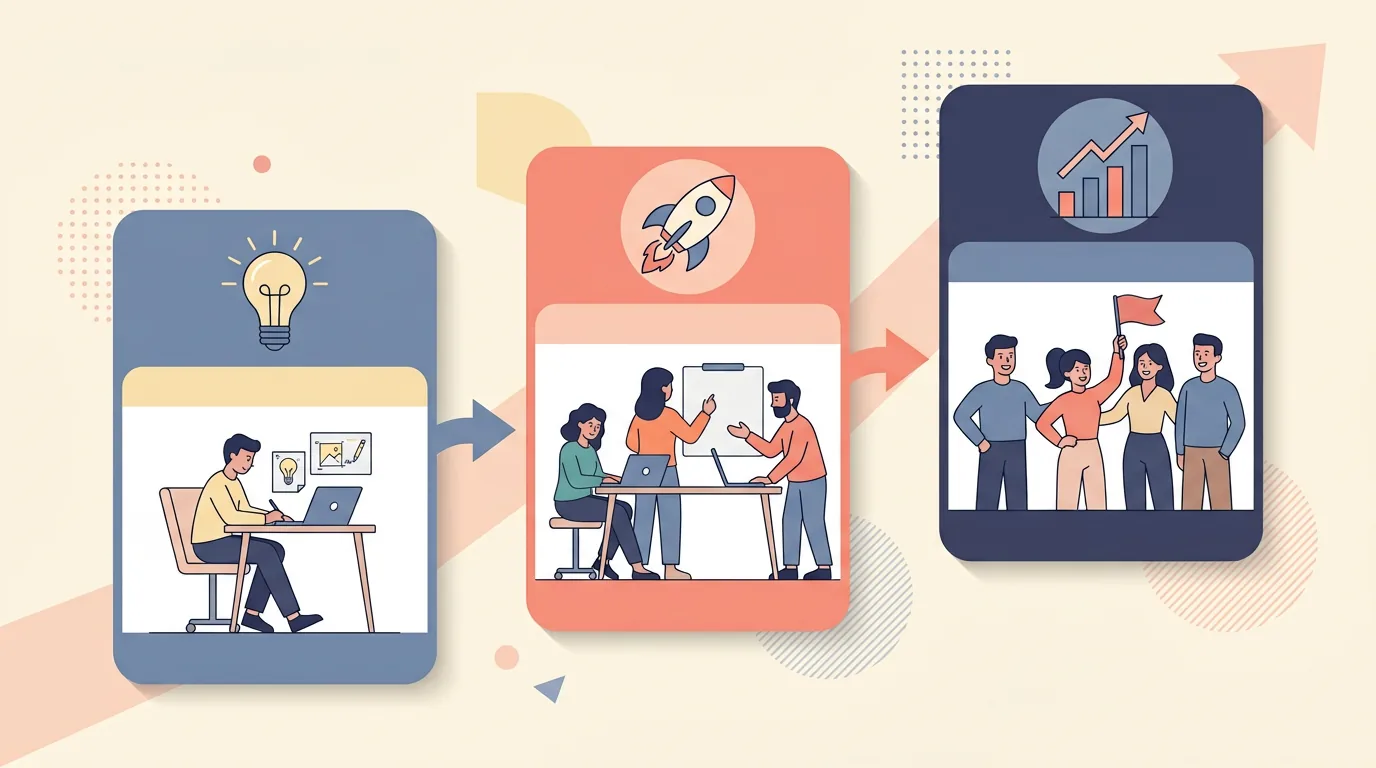
Design needs change as the company grows, and hiring the right help for the wrong stage is one of the most common money-wasters.
At the idea stage, before anything is built, you don't need a full product design. You need speed and cheap learning: user flows, rough prototypes, something testable that validates whether the concept makes sense before you spend on engineering. A strong freelance product designer is often the perfect fit here. The work is bounded, fast-moving, and half of it gets thrown away, which is the point.
At MVP stage, the calculus shifts. You now have a defined product, a launch date, and users or investors who will judge it. This is also where the scope quietly expands: flows you thought were simple grow edge cases, error states multiply, and the handoff to engineers surfaces questions nobody answered. A single freelancer can stall here, not from lack of skill, but because one person can't cover product logic, UX, visual design, and the design system at once. A small agency team absorbs the expansion without the project freezing, and that's usually when agencies start earning their price.
After launch, the needs change again: iteration on real user data, design systems your engineers can build from, conversion work on onboarding and activation. This is ongoing product design, and it needs continuity, whichever shape of partner provides it.
For most startups the honest pattern is a hybrid: freelance help for early validation, an agency team for the real build. Use both strategically instead of turning it into a religion.

What a Good Agency Delivers for a Startup MVP
Scope is where founder expectations and agency deliverables usually clash, so here's what a complete product engagement should produce.
The chain runs: research synthesis, so decisions have evidence behind them. Information architecture, so the product's structure is deliberate. Wireframes for every core screen. High-fidelity mockups. An interactive prototype you can put in front of users and investors. A lightweight design system, meaning consistent components and rules, not a 200-page document. And developer handoff specs clean enough that engineers don't need to guess.
That last item deserves emphasis, because handoff quality is invisible until it's missing. Ambiguous designs become engineer interpretations, engineer interpretations become rework, and rework at startup stage burns the runway directly. An agency that designs with build constraints in mind, ideally with developers on staff or in the conversation early, saves more than its fee in avoided rework.
One calibration worth knowing: an MVP shouldn't be uniformly polished. It should be production-grade in the flows that carry trust, sign-up, onboarding, payment, and deliberately rough almost everywhere else. Agencies that understand startups design to that standard. Agencies that don't will happily burn your budget polishing screens nobody reaches in the first week.

The Hidden Cost Founders Miss: Management Overhead
The visible cost of design help is the invoice. The hidden cost is your calendar.
With a freelancer, you are the project manager. You write the briefs, chase timelines, check quality, align stakeholders, and make the hundred small decisions that keep work moving. That's easily several hours a week, and founding teams running low on exactly that resource feel it hard.
An agency absorbs most of that overhead internally: a point of contact, structured check-ins, a team that coordinates itself. You make the decisions that matter and skip the ones that don't. The fee is higher; the drain on the founding team is lower.
There's also a bus-factor asymmetry that rarely makes the comparison tables. A freelancer who gets sick, lands a bigger client, or simply disappears mid-project leaves you restarting with someone new who knows nothing about your product. An agency team has redundancy: the product knowledge lives in the team, documented in the design system and handoff files, not in one person's head. For a startup on a funding timeline, that continuity is worth real money the day anything goes wrong.
Neither answer is universally right. The honest question is how much management bandwidth your team actually has this quarter. Founders deep in code or fundraising usually get more value from an engagement that manages itself, even at a higher price, because their attention is the scarcest resource the company has.
How to Pick a Startup Design Agency
Five checks, tuned for startup reality.
Startup case studies first, and recent ones. You want proof they've shipped zero-to-one products recently, not enterprise logos from a decade ago. Read how the case studies handle scope changes; startups always have them.
Scope flexibility second. Ask directly how they handle a pivot mid-project. The wrong answer is anything implying it never happens. The right answer describes short phases, checkpoints, and pricing that survives change.
Handoff quality third. Ask to see a sample handoff package, anonymized if needed. Developers will thank you, and the quality of those documents predicts how smoothly your build goes.
Ownership fourth. Get it in writing that you own everything: files, prototypes, the design system, everything. Non-negotiable, whoever you hire.
And red flags last: guaranteed outcomes before seeing the product, discovery phases that last longer than your runway, no questions about your users, and any discomfort when you ask who exactly will work on the project. Standard checks, startup stakes.
That last set of checks happens to describe how we work at Quadiz. We're a design and development studio built for exactly this stretch of a startup's life: design and development under one roof, so handoff friction mostly doesn't exist, and our case studies include SaaS platforms and apps built from early concept to launch. If you're at the MVP stage and want a team that treats your runway like it's ours, book a free call and let's scope it together.
Tags:#Startup Design#MVP Design#Product Design Agency
Written byFounder & Lead Developer
Nayef
Visit Website ↗Tech enthusiast, lead developer, and founder of Quadiz.