Founders comparing mobile app ui ux design services usually carry the same quiet fear: paying thousands for "pretty screens" that collapse on contact with real users. The fear is justified only when you buy decoration. Done properly, what you are buying is a sequence of tested product decisions, captured in Figma before any engineering budget moves. This guide shows exactly what the service includes, what it costs, and how to tell craft from presentation.
Mobile App UI/UX Design Services: The Working Definition
Mobile app UI/UX design services cover the research, structure, and visual design of a mobile application before it is built: user research, information architecture and user flows, wireframes, high-fidelity screens for iOS and Android, a clickable prototype for user testing, and a documented handoff for developers. UI is how the app looks; UX is how it works and feels in a human hand. A design service sells both as one deliverable, because either half alone produces an app that is pretty but unusable, or logical but lifeless.
What UI/UX Design for Mobile Apps Actually Covers
Six deliverables, each with a job to do:
- User research and personas. Who the app serves and what they are trying to do when they open it. Skipping this is how apps end up designed for the founder's taste.
- Information architecture and user flows. The map of every screen and route through the app. Most expensive product mistakes are visible right here, for free, before any pixels exist.
- Wireframes. Low-detail structural drafts of each screen, reviewed and revised cheaply. Where features get cut or clarified.
- High-fidelity UI design. Branded, polished screens following iOS and Android platform conventions, not generic web layouts squeezed small.
- Clickable prototype and user testing. A tappable simulation put in front of real people. This is where flows are proven or corrected while changes still cost hours.
- Design system and developer handoff. Colors, type scales, components, spacing, and states, documented so engineers build what was designed instead of improvising it.

Why Mobile UX Design Is Its Own Discipline
Mobile UX design is not desktop design at 375 pixels. Thumbs drive navigation, so primary actions live inside the reach arc at the bottom of the screen, and tap targets need room for real fingers. Gestures replace menus, which means the most-used paths must be discoverable without labels. iOS and Android users bring different habits: back behavior addresses, navigation bars, and sheet patterns differ per platform, and shipping one generic layout to both stores makes the app feel foreign on at least one of them. Then there is reality itself: notifications interrupt, calls arrive, connections die mid-flow. A mobile UX survives interruption gracefully, saves state, and resumes where the user was thrown off. These are exactly the details user testing on a prototype exposes before they become one-star reviews.

Process and Timeline: What Good Looks Like
A focused app design engagement runs about 3 to 6 weeks across five phases: discovery and research (week 1), flows and architecture (week 1 to 2), wireframes with an approval gate (week 2 to 3), high-fidelity UI with a second approval gate (week 3 to 5), then prototype testing and final handoff documentation. The gates matter as much as the calendar: wireframes get signed off before UI begins, and the visual direction gets approved before full screen production, which keeps revisions small and honest instead of endless. Complex products with dozens of screens stretch to 6 to 10 weeks, and any provider promising a full design in five days is skipping exactly the phases that prevent rework.
What It Costs, and How to Spend Less Safely
Market ranges cluster by scope: a simple 8 to 10 screen app typically runs $2,000 to $5,000, a standard 20 to 30 screen product $5,000 to $15,000, and complex builds with a full design system $15,000 to $30,000 and beyond, with hourly rates from about $50 to $150 depending on region. Roughly a third of the effort sits in research and structure rather than pixels, which is also why skipping design tends to add back around 30 percent in development rework later. The levers that genuinely lower the bill are a tight screen inventory, one validated design direction instead of three explorations, and a focused scope instead of a kitchen-sink brief. That last one is precisely how our Mobile App Design service starts at $600: a bounded 3 to 6 week engagement covering flows, wireframes, hi-fi iOS and Android screens, navigation patterns, and a tappable prototype, designed to prove the product before build budgets move.
How to Verify a Design Partner's Craft
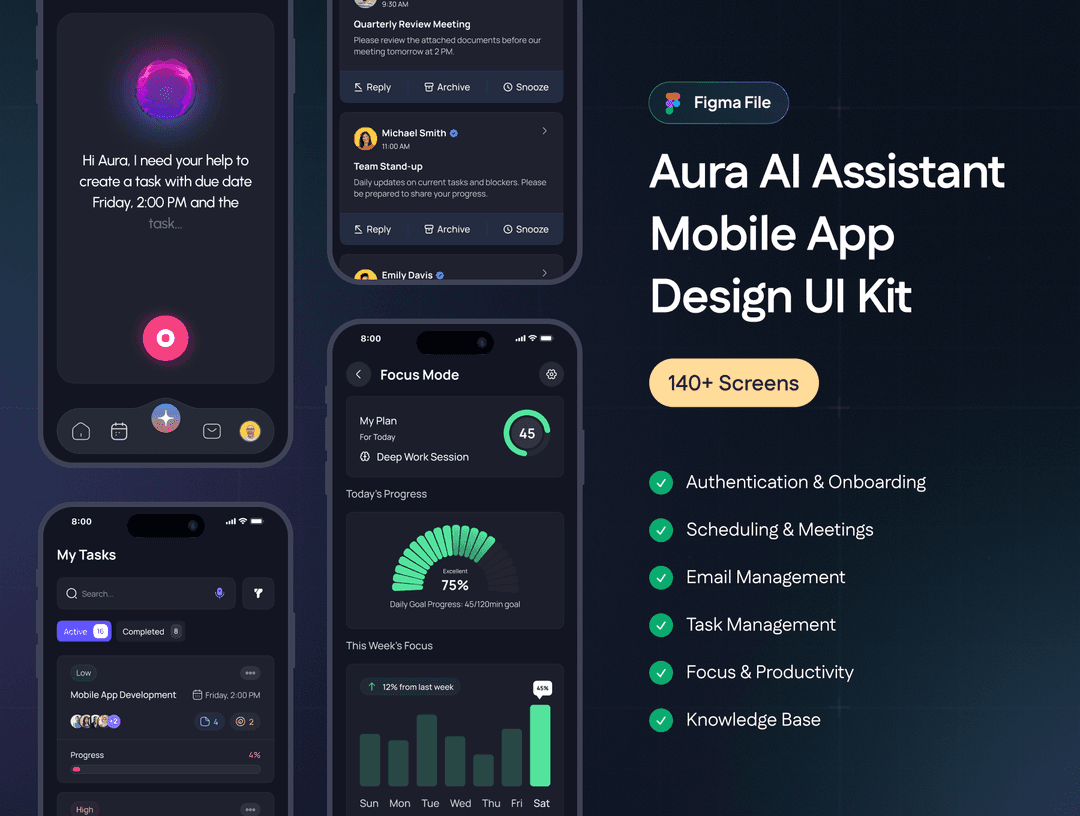
Before comparing prices, compare evidence, in order of effort required. First, install something they designed: shipped apps do not hide, and ours are public, including Chess Timer, where distraction-free screens and gesture patterns can be judged directly. Second, inspect their public design work: our mobile interface craft is also on the UI8 marketplace as production UI kits, like Tourly, an AI travel planning app design, and Aura, a professional AI assistant interface, both reviewed and approved by UI8's marketplace standards. Third, read case studies with outcomes, not mood boards; mobile work like the travel planner in our works shows process, constraints, and results side by side. A partner who survives those three checks has earned the right to talk about money.
Frequently Asked Questions
What is included in mobile app UI/UX design services?
Research and personas, information architecture and user flows, wireframes, high-fidelity platform-specific screens, a clickable prototype with user testing, and a documented design system with developer handoff. Anything less is screen decoration sold as design.
How much do mobile app design services cost?
About $2,000 to $5,000 for a simple app, $5,000 to $15,000 for a standard product, and $15,000 to $30,000 or more for complex builds with design systems. Focused MVP design phases can start far lower, from around $600, when scope is deliberately tight.
How long does mobile app design take?
Three to six weeks for a focused scope covering flows to prototype, six to ten weeks for complex products. Proposals promising everything in a few days are cutting research and testing, the phases that save the project.
Can I skip UX and go straight to development?
You can, and many teams do, once. The industry rule of thumb is that skipping the UX phase returns as roughly 30 percent extra development rework, paid at engineering rates, plus the usability debt users review in public.
Do I need separate designs for iOS and Android?
You need one design system with two platform adaptations. Screen layouts largely transfer, but navigation patterns, back behavior, sheets, and controls follow each platform's own conventions, so a competent service delivers both variants from the same foundation.
Buy the Decisions, Not Just the Pixels
| Your position | The smart first move | Next step |
|---|---|---|
| App idea ready, nothing designed | A focused flows-to-prototype design phase | Mobile App Design service, 3 to 6 weeks from $600 |
| Comparing design partners | Judge craft first, then scope together | Review our works, then get a quote |
A design service earns its fee in the changes that never reach a developer's keyboard. That is the whole purchase.
Tags:#Mobile App Design#UI/UX Design#Design Services
Written byFounder & Lead Developer
Nayef
Visit Website ↗Tech enthusiast, lead developer, and founder of Quadiz.