Few searches sound as expensive as enterprise mobile app development, and the first security review, the first legacy integration, and the first department that refuses to use the thing you built usually explain why. This guide covers what actually makes enterprise apps different, the five failure points behind most stalled programs, the custom-vs-platform decision, and a roadmap that survives procurement.
Enterprise Mobile App Development: Definition and Real Differences
Enterprise mobile app development is the design and delivery of mobile software for an organization's own workforce, partners, or controlled customer groups, built to enterprise standards of security, compliance, systems integration, and lifecycle governance. The product goal is not app-store fame; it is operational outcomes like faster approvals, fewer errors, and work that continues when the office Wi-Fi does not.
The differences from consumer apps are structural, not cosmetic:
| Factor | Consumer app | Enterprise app |
|---|---|---|
| Users | The public | Employees, partners, invited clients |
| Access | Email signup | SSO with MFA, role-based permissions |
| Integrations | A few public APIs | ERP, CRM, HR and legacy systems |
| Compliance | Store policies | HIPAA, GDPR, SOC 2, PCI DSS by industry |
| Distribution | Public app stores | Stores plus MDM-managed private rollout |
| Failure cost | Bad reviews | Leaked data, fines, stalled operations |
The 5 Things That Break Enterprise Apps
1. Security Treated as a Final Checklist
Retrofitted security fails audits and breaches trust. Enterprise grade means threat modeling against OWASP mobile risks at design time, encryption everywhere, role-based access control, dependency scanning inside CI/CD, and an independent penetration test before launch. Security is an architecture you build in, not a document you sign off.
2. Legacy Integration Reality
Your app is only as useful as the systems behind it, and those ERP and CRM instances were never designed for mobile traffic. The stable pattern is an API or "backend for frontend" layer that decouples the app from legacy volatility, so a slow mainframe becomes a design constraint rather than a crash report.
3. Performance and Offline Expectations
Field teams work in warehouses, basements, and dead zones. If scanning, approvals, or data capture must keep working without connectivity, offline-first sync is a launch requirement, not a phase-two wish. Decide per workflow, early, what must function at zero bars.
4. Employee Adoption Deaths
The most expensive enterprise app is the polished, compliant one nobody opens. Internal users tolerate far less friction than vendors assume, because they compare your app to the consumer apps on the same phone. Clunky login, cramped forms, and twelve taps for a daily task guarantee shadow spreadsheets by week three. Adoption is a design problem, which is why design gets its own phase in the roadmap below.
5. Governance of Many Apps
One app becomes five, five become twenty, and suddenly nobody knows which version finance uses or who approved the unlisted inventory app IT never vetted. Governance means a named owner per app, version and data policies, MDM or MAM distribution rules, and a retirement plan. It is boring, and it is the difference between a platform and a pile.

Custom Build or an Enterprise Mobile App Development Platform?
An enterprise mobile app development platform (the MADP category) offers visual builders, pre-built integrations, and one-codebase deployment across iOS and Android, and the model has real traction: low-code tooling already drives the majority of mobile development tasks and cuts delivery cycles by roughly 50 to 70 percent for fitting use cases. Choose when:
| Choose the platform when | Choose custom when |
|---|---|
| The app is a standard internal workflow (approvals, forms, dashboards) | The app must feel exceptional to demanding users |
| Speed and cost dominate, differentiation does not | Integrations are complex or business logic is unusual |
| Compliance needs fit the vendor's certifications | You need full control of data residency and code |
| IT wants to own maintenance without a dev team | You are building a product, not just a tool |
Most mature organizations land on hybrid: platforms for the long tail of internal utilities, custom engineering for the two or three apps that carry real competitive weight. Settle this question per app, not per company, and settle it before vendors are in the room.

A Roadmap That Survives Procurement
Phase 1, discovery and threat model: map the workflows, data sensitivity, offline needs, and compliance scope. Two to four weeks; the output is a one-page risk and scope sheet everyone signs.
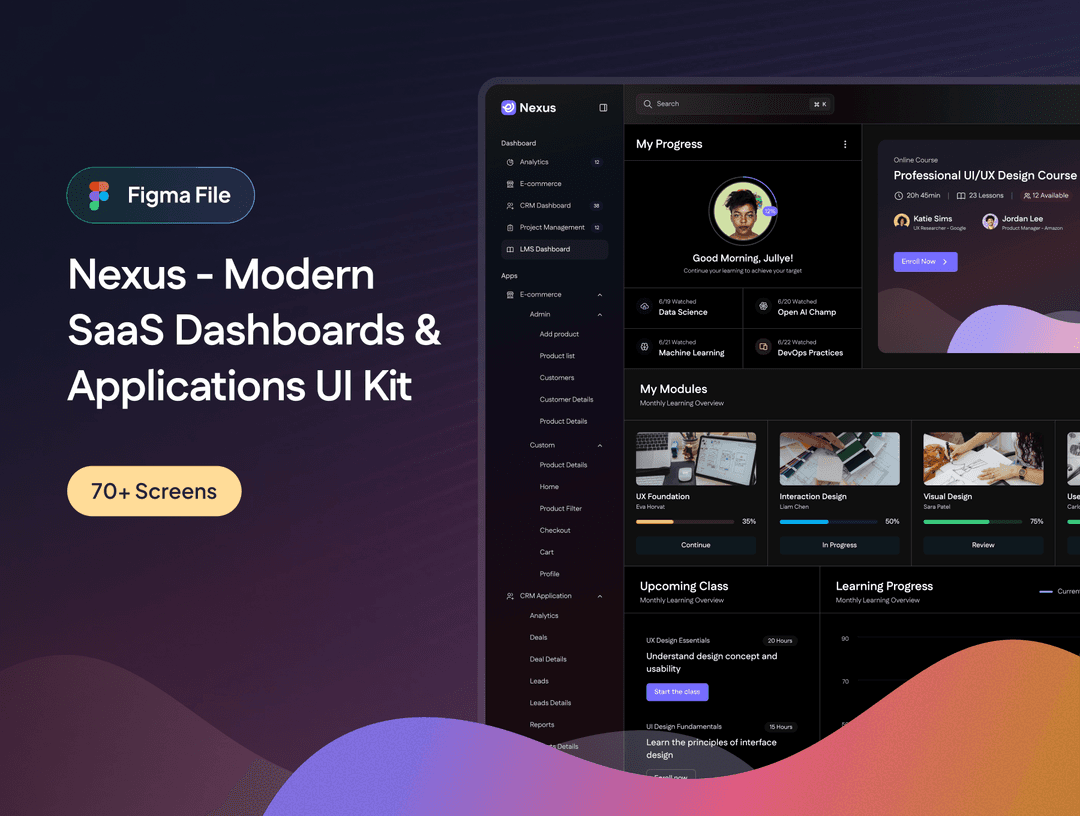
Phase 2, design system and prototype: enterprise UX does not mean grey grids. A shared design system keeps dozens of screens consistent and fast to build; our Nexus UI kit for SaaS dashboards and applications, shipped in light and dark mode, is designed for exactly this job, and our Mobile App Design service turns it into user flows, wireframes, and a tappable prototype in 3 to 6 weeks from $600.
Phase 3, single-department pilot: one team, one workflow, thirty to ninety days. Adoption and task-time metrics here decide whether the program scales.
Phase 4, hardening: penetration test, MDM or MAM enrollment, data-loss rules, and audit-ready logging before any wider rollout.
Phase 5, scale by domain: add departments and apps on the same design system, same API layer, and same governance rules, which is how one app becomes a platform without becoming chaos.
Frequently Asked Questions
What is enterprise mobile app development?
It is building mobile software for an organization's own workforce, partners, or controlled customers, meeting enterprise requirements for security, compliance, systems integration, and governance, and measured by operational outcomes rather than downloads.
How much does an enterprise mobile app cost?
Plan in the complex-app tier: roughly $85k to $150k and up, over 8 to 12 months for an integrated, compliant build. Design and discovery are a small fraction of that; skipping them is how the big number doubles.
Which compliance standards matter for enterprise apps?
By industry: HIPAA for health data, GDPR for EU personal data, SOC 2 for SaaS vendors, PCI DSS for card payments. Underneath all of them sits the OWASP Mobile risk baseline for app-level security engineering.
Native or cross-platform for enterprise mobile apps?
Cross-platform frameworks cover most internal fleets well, one team serving iOS and Android through MDM distribution. Reserve dual native builds for extreme performance needs or hardware-level security features; either way, device management policy matters more than framework choice.
Should we use a low-code platform or build custom?
Use the decision table above per app: platform for standard workflows and speed, custom for differentiation, complex integration, and control. If in doubt, prototype the riskiest flow first; the prototype usually answers the question honestly.
Start With the Part That Decides Adoption
| Where your program stands | What to do first | Next step |
|---|---|---|
| Enterprise app planned, nothing designed | A design system and tested prototype before platform or vendor commitments | Mobile App Design service, 3 to 6 weeks from $600 |
| Evaluating partners for the build | Review shipped work, then scope together | See our works, then get a quote |
Enterprise mobile app development rarely fails on technology. It fails in the gap between what compliance demanded and what humans would actually use; design closes that gap first.
Tags:#Mobile App Design#Enterprise#App Development
Written byFounder & Lead Developer
Nayef
Visit Website ↗Tech enthusiast, lead developer, and founder of Quadiz.